Reformer Pilates for Lower Back Pain from Sitting

You stand up from your desk after a Tuesday of back-to-back meetings, and there it is: the familiar tightness in your lower back, the pinch that has been showing up for weeks now. You’ve been stretching. Furthermore, you’ve tried foam rolling, added deadlifts to your strength training routine, and done yoga on and off. Nothing has undone it because none of it addresses what is actually happening. Your body has adapted to a shape it was not built for, and the shape is holding on.
Eight hours a day, five days a week, month after month, the body concludes that this is the new normal and reorganizes around it. The lower back you feel at 4 pm is not the source of the problem. It is the messenger.=
The good news is that adaptation runs in both directions. Eight weeks of the right corrective practice can undo a surprising amount of what months of sitting have built. What follows is what the right practice actually looks like on a reformer, and why sitting causes lower back pain in the first place, in more mechanical detail than you have likely been given before.
Why sitting causes lower back pain (not the reason you've been told)
The story you have probably heard is that sitting weakens your back, so you need to strengthen your core. That is not wrong, but it is not the whole picture, and treating a weakness that is really a compensation is why most fixes do not hold.
Here is what is actually happening. When you sit, your hip flexors are held in a shortened position. That group of muscles includes the psoas, which runs from the front of your spine through your pelvis to the top of your thigh. If you keep anything shortened for eight hours a day, the body adapts. The psoas becomes chronically short. Because it attaches to your lumbar spine, a short psoas does not stay quietly in the hip. It pulls.
Christine Clark, one of our senior instructors and trained in Stott Pilates and myofascial assessment, often describes the pelvis as a bowl of water. When the hip flexors shorten, the front of the bowl tips forward. Water spills over the front lip. To keep from falling forward, your lumbar spine arches more sharply to compensate, and the vertebrae start to compress into each other. That compression is what you feel at 4 pm.
Meanwhile, up above, the same sitting posture has been slowly collapsing your thoracic spine, the middle section of your back, the one that is supposed to bend and extend the most. Screens pull the head forward. Shoulders round in. The thoracic spine loses its natural mobility, and now the lumbar spine has to do two jobs at once: hold you upright, and create the extension the thoracic spine used to. It is asked to be more mobile than it should be, at exactly the moment it needs to be stable.
And the posterior chain has switched off from disuse. The glutes, the deep spinal stabilizers, the muscles that should be holding your posture together: none of them are recruited when you sit. Muscles that do not fire lose the neural pathways that let them fire, and over months those pathways go quiet.
Three things at once, then. Hip flexors too short. Thoracic spine too stiff. Posterior chain asleep. The lower back is caught between all three, doing work it was never meant to do. No amount of stretching the sore spot will fix that.
Why the reformer is different from stretching, yoga, or the gym
If you have already tried stretching, yoga, and the gym, and none of it has held, it is worth understanding why the reformer works differently, and why the difference is significant for a back that is already sore.
Stretching lengthens tissue passively. You settle into a position, you breathe, and the muscle releases a little. Muscles that have adapted over months do not hold a passive stretch for long. As soon as you stand back up and return to your desk, the pattern reasserts itself. The stretch felt good; it did not change anything structural.
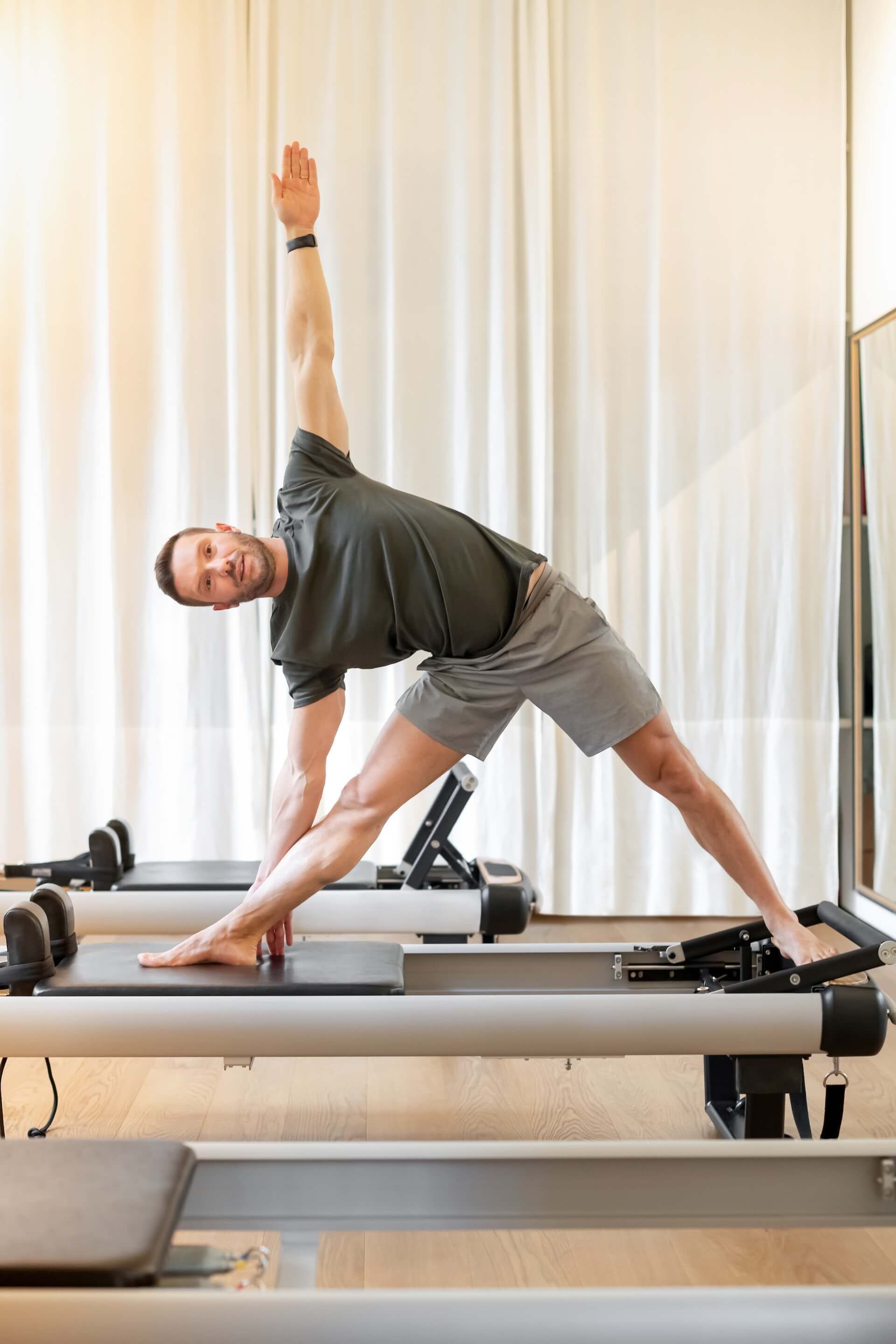
The reformer trains the same muscles to lengthen
under load. That is a technical distinction, and it matters more than it sounds. When your hip flexor lengthens against spring resistance, the nervous system encodes the new range as functional, not incidental. That is what makes the change stick.
Then there is the load itself. Spring resistance can be dialled
lighter than your own body weight, which matters when your back hurts, and mat-based work asks you to hold your own weight in positions that aggravate the issue. The reformer lets you work in ranges that would otherwise be off limits.
The carriage also creates spinal decompression positions that no other setup replicates. Lying on a sliding surface with the spring taking part of the load, the vertebrae can gently separate rather than compress. Backs that have been under pressure all day tend to respond to this specific sensation with immediate, obvious relief.
And because our group classes cap at five, an instructor can actually see whether your pelvis is tipping, whether your ribs are flaring, whether the movement you are doing is the movement you think you are doing. Corrective work fails when alignment errors go uncorrected. In a class of twenty, they do.
What eight weeks of corrective practice actually looks like
Corrective work is not a workout, and the timeline reflects that. You are not training for strength gains you can measure in a week. You are asking your nervous system to remap a pattern it has practiced for years. That takes time, and it takes repetition at a specific cadence.
Two sessions per week are the honest minimum for adaptation. One a week maintains what you already have. Three sessions per week are faster progress if the schedule allows. Below two, the pattern reasserts itself between sessions faster than you can rebuild it.
Weeks 1 & 2:
Awareness before change
You will leave the studio feeling different, though not necessarily better yet. You will feel aware. Where your ribs sit. How your weight moves through your feet. That your shoulders have been living somewhere they should not. This proprioceptive shift is the ground floor. Nothing else works without it.
Weeks 3 to 5: The mechanical changes begin
Hip flexors start to release. Glutes wake up and fire when they should. Thoracic mobility opens, and you feel the difference in how you sit and stand. Most clients report first real relief in this window. Not a dramatic before-and-after, but a stretch of two or three days when the familiar ache does not show up at its familiar time.
Weeks 6 to 8: The pattern holds
The new posture holds between sessions. This is when clients describe sitting through a workday without pain, or standing up from a chair without the reflexive brace. The change is no longer something the studio produces. It is something your body has learned.
A NOTE THAT MATTERS
If your back pain is acute, radiates down your leg, or involves numbness or weakness anywhere, please see a physiotherapist, osteopath, or physician before starting reformer work. Corrective Pilates is a resilient tool. It is not a substitute for a clinical assessment when one is needed.
The reformer sequences that do the work
The program is intentional rather than exhaustive. Four families of movement, sequenced across your sessions, do most of the heavy lifting in terms of correction. Your instructor will select and progress each based on what your body is showing them at the moment.
1 ·
Hip flexor lengthening under load
The kneeling lunge on the reformer is the corrective version of the lunge stretch you may know from yoga. One knee rests on the carriage, the other foot on the platform. As you press the carriage back, the front of the hip lengthens against the spring. Not because you are forcing a stretch, but because you are asking the psoas to release while it works. Combined with a single-leg stretch that adds spinal stability, this is where the shortened hip finally learns a longer resting length. Repeated across sessions, it holds.
2 · Thoracic extension over the barrel or long box
To restore movement to a collapsed thoracic spine, the vertebrae need to move over a supported curve. Supported back extension over the barrel or long box uses the equipment as scaffolding, letting your mid-back extend into a shape it has forgotten. A swan preparation adds arm resistance to teach the shoulder blades to move independently of the neck. When the thoracic spine can extend again, the lumbar spine stops being asked to make up the difference, and much of what you have been feeling releases on its own.
3 · Posterior chain activation
Bridging on the reformer wakes up the glutes and the deep spinal stabilizers in a specific way. The carriage moves as you lift and lower, which forces the muscles to fire eccentrically as well as concentrically. Footwork variations (heels, toes, wide stance, narrow stance) recruit the posterior chain from different angles, teaching muscles that have been quiet how to participate again. Feet-in-straps work adds the hamstrings and the deep hip. These are the muscles your posture has been outsourcing for years. Bringing them back online is what makes the correction sustainable.
4 · Spinal decompression
After sequences that ask your spine to work, decompression gives it what it has been asking for since Tuesday. Short spine on the reformer places you on your back with the feet in straps, and lets the spring gently draw the spine into length as the legs move overhead. Spine stretch forward with resistance uses the carriage to guide a controlled forward fold that lengthens the whole posterior chain. These are the sequences most clients want to stay in longer than the class allows. Backs that have been compressed all day recognize the sensation immediately.
How you'll know it's working
The changes you are looking for are not dramatic, and that is the point. Corrective work succeeds when normal function returns, when the body stops sending signals it should not have been sending in the first place. What you notice, if you are paying attention, tends to look like this:
You sit through a full hour of meetings without shifting position.
You stand up from a chair without the first-step wince that had become automatic.
You sleep on your back without waking with tension across your lumbar.
You catch yourself standing well in line at a café, shoulders where they belong, weight even through your feet, without having consciously corrected.
You reach for something on a high shelf, and your ribs move the way they used to, before the years of screens.
These are the markers. They accumulate quietly across the eight weeks, and one day you notice that the thing you used to expect from your body is not happening anymore.
Where to start
If your back is actively sore, the honest recommendation is to start with a
one-on-one private session before joining a group class. This is not a sales tactic. It is how corrective work is properly sequenced.
A private lets an instructor read your pattern before you ever step into a class. How your pelvis sits. Where your ribs live. Which side compensates for the other. Whether the pain has a mechanical explanation the movement can address, or whether something else needs to be looked at first.
The first private is an assessment, not a workout. You will move through basic patterns while the instructor watches. You will get an honest read on what your body is doing and a plan for what to work on. There is no pressure to perform, and no requirement to know anything about Pilates going in.
Most clients move into
small-group 8-week sessions after two or three privates, once the fundamental patterns are established and the group format can build on that foundation rather than have to create it. By that point, the corrective work is doing what it should, and the group setting adds the consistency that makes it hold.
Common questions
How many reformer classes do I need to see back pain improve?
Most clients notice initial changes in awareness and posture within the first two weeks, and report meaningful relief between weeks three and five. Two sessions per week are the honest minimum for adaptation; one a week maintains what you have already built. The eight-week arc reflects how long the nervous system needs to encode a new pattern that holds between sessions.
Is reformer Pilates safe if I already have back pain?
For most people with sitting-driven lower back pain, yes. The reformer is often safer than mat-based work or the gym because spring resistance can be dialled lighter than body weight, and decompression positions are built into the equipment. That said, if your pain is acute, if it radiates down your leg, or if you have any numbness or weakness, please see a physiotherapist, osteopath, or physician before booking. We are happy to work alongside your clinician once you have their assessment.
Can I do reformer Pilates if I've never done Pilates before?
Yes, and beginning without prior experience is often an advantage. There are no habits to unlearn. We recommend that new clients start with a private session so the instructor can properly introduce the equipment and observe your movement patterns before you join a group. Once the fundamentals are in place, the small-group 8-week sessions carry the work forward.
A NOTE FROM THE STUDIO
This article is educational and is not a substitute for medical advice. If you are experiencing acute pain, radiating symptoms, or numbness, please consult a healthcare provider before beginning a movement program. Pilates West Island was founded by Kyle Murray and Jim Roberts. The instructors at the studio are certified through Stott Pilates/Merrithew and regularly work alongside physiotherapists and osteopaths in the West Island community.
BEGIN WITH INTENTION
Book an Intro Private Session
Come in. Let us see how you move. We'll take it from there. No pressure, no packages to commit to upfront.
Recent Posts